I'm almost finished with Dead Space 2, and I have to say that it has been one hell of a ride so far. I originally started the first game back when it came out in 2008, but I only played it for about twenty minutes, due to the amazingly poor quality of the PC port. I dredged it out again recently because of a friend's high recommendations and because Dead Space 2 was coming out soon and was getting a lot of hype. I played it with a controller this time (the mouse/keyboard controls really make the game unplayable), and stuck it out through the first (rather boring) chapter. I am so glad I did.
Dead Space isn't just a good game. It's a great game, and when I beat it, I immediately bought, installed, and played the sequel. As long as I have played video games, I have never beaten a game and started its sequel on the same day. It's usually just too much of the same thing for me, but Dead Space was that good. One of the things that made it so good was the characterization of the main character, Isaac Clarke, which is odd because throughout the first game, he doesn't utter a single word. Isaac is yet another example of the tired "silent protagonist" trope, a concept so inane and outdated that it makes the save points littered throughout both games look like the way of the future. Instead of speaking, Isaac's thoughts are written in his "personal journal," essentially the quest log. It's actually pretty interesting, and it got me to read to read the log for every quest, which is not something that I would normally do.
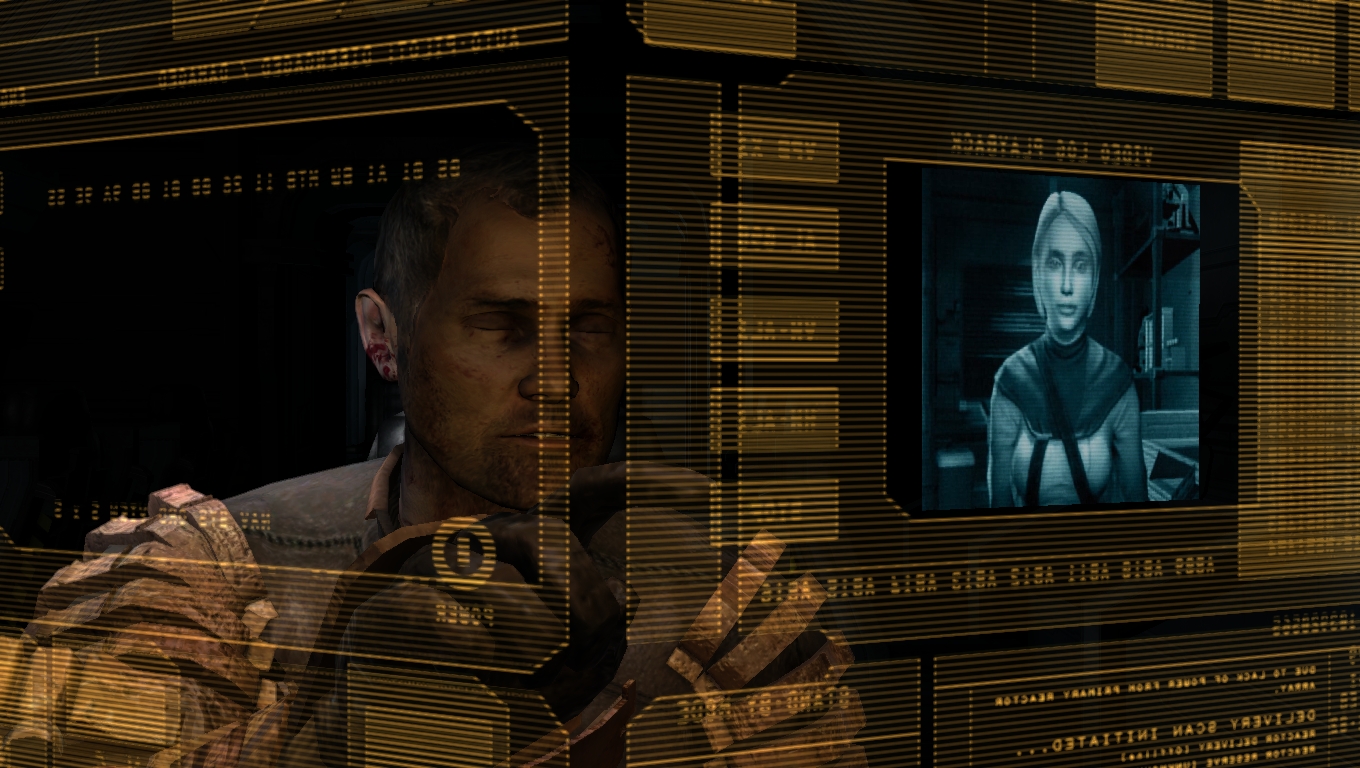
In the second game, in addition to keeping a journal, Isaac is fully voiced, which gives him an opportunity to talk about things other than which part of the ship is broken and how he needs to fix it. I still read the journal, however, and it was going great until towards the end of the game. I checked my journal, and read that Isaac was looking for a certain character that he was particularly worried about. I then moved forward a couple of feet, which triggered a cutscene in which the character that Isaac was looking for dies a horrible horrible death. After the cutscene was over, I pulled up Isaac's journal to see what he had to say about it, but according to the journal, Isaac was still looking for that character and was still very worried. That was the first time in either game that the illusion was shattered enough that it occurred to me that there was someone who actually wrote these journal entries. Someone over at Visceral Games actually took the time to put this much thought into characterizing Isaac through his mission objectives and, for the most part, did really, really well with it.
What an awesome job. I want that job.
Most quest logs are terrible. The ones that do try to take the first-person narration style usually don't work and are filled with unnecessary filler. The others are usually short, to-the-point, and boring. Borderlands did a pretty decent job, but after a couple of hours they descended into tedium. Alan Wake was interesting, but that game didn't really need mission objectives, and ended up just rehashing recent events. I think quest logs need to be spiced up a bit, and I think it would be awesome to be the guy that does it.
I went through the Dead Space credits to see if I could find out who this guy was, but there was not a single writing credit. Not one. There were a bunch of general "designers" credited, but nothing specific in terms of writing. Oh, well. I guess I'll have to go back to my old dream of being the guy that designs the "options" menu.
Tuesday, February 1, 2011


Friday, January 14, 2011
Resistance is Futile
A while back, a friend of mine recommended that I play an old Star Trek game from 1996 called Star Trek: Borg. It's a moderately short interactive movie which has some interesting puzzles and features John de Lancie reprising his role as Q. It sounded like fun, and I love playing old games, so I decided to give it a shot.
I say I love playing old games, but really there's more to it than that. What I really love is figuring out how to play old games. I've spent many hours tweaking settings in a Playstation emulator trying to optimize Resident Evil. I dual-boot 32-bit Windows XP and 64-bit Windows 7 so that I can play the games that run in one and not the other. One of the twelve icons I have on my desktop is a shortcut to DosBox. It's the thrill of getting something working that didn't work before that really gets me excited.
Therefore, I apologize for geeking out a bit. The rest of this post will be rather technical and boring. Spoiler alert: I got Star Trek: Borg working, and it was hard.
What made Star Trek: Borg interesting was that any attempts to get it working in a modern operating system were pointless. Upon installing the game, the installer makes three checks. The first is to ensure that the host operating system is Windows 95, the second is to ensure that the resolution is set to 640 x 480, and the third is to ensure that the color settings are set to 16-bit color. These three checks meant that none of my usual tricks were going to work. I was going to have to get a Windows 95 machine.
Of course, it didn't have to be a real Windows 95 machine. Getting Windows 95 working on modern hardware is pretty much impossible, and I was not going to buy an antique computer to play an FMV game. So I decided to set up a virtual machine running Windows 95.
That was as far as I got before I started running into problems.
The first thing that I needed to do was get some virtualization software. As a student, I have access to Microsoft's Dreamspark program, which gives out free software to people with valid student IDs. One of the programs that they offer is Virtual PC 2007.
Perfect.
So I downloaded Virtual PC, but apparently it doesn't work in 64-bit operating systems, and I wanted to do everything in Windows 7, so switching to XP wasn't an option. I happened to have an older version of VMware Workstation, so I decided to use that instead. I also had a physical copy of the Windows 95 CD-ROM that I found in a drawer when my family decided to sell their house a couple of years ago. I installed VMware Workstation, created a new Windows 95 machine, and inserted my disk.
Nothing happened.
I played with the boot order, checked the settings again, made sure that the virtual CD-ROM drive was reading properly, and tried again. Still nothing. I was a bit stumped, but I decided that it had to be the disk that wasn't working. To test this, I created a new identical machine and installed Windows 98 on it. It worked like a charm. Now I knew that there had to be something wrong with the Windows 95 disk, so I went off in search of another copy. What I found was the thirteen floppy disks for the original build of Windows 95. I hesitated to do this because I knew that the original build not only had issues that were fixed in later releases, but also that it came without a web browser. That meant that it would be tricky to do things like download drivers and patches.
Well, I did it anyway, and the installation really went off without a hitch. The problem came when I tried to install the VMware Tools that come with Workstation. Included in the VMware Tools are the virtual video drivers that would allow me to set my resolution and color scheme. Whenever I tried to install the VMware Tools, Windows would give me the all-to-familiar "illegal operation" dialog box that, honestly, I had almost forgotten about. There wasn't too much I could do. I couldn't get online to download a solution, and if I couldn't install the video drivers, I wouldn't be able to set my color scheme beyond 16 colors, and I needed to get up to 16-bit color.
So I went off in search of another copy of Windows 95. This time I found the latest release that I could, the OEM Service Release 2.5, which was released in late 1997. This version came with Internet Explorer, was released on CD-ROM so I didn't have to keep switching floppies out, and was much more stable. It also came with Hover!, a capture-the-flag style 3D hovercar game that I sunk quite a few summer afternoons into as a kid. That last one didn't really help me achieve my goal, but it was an added bonus. This time installation ran smoothly and the VMware Tools installation ran, but there were errors. Specifically, the video drivers didn't install fully. That was okay though, because they provided instructions at the end of the installer on how to install the drivers manually. I did so and rebooted. Much better.
To test things, I got out my original Fury3 disk. It installed fine, but I noticed that there was no sound.
Sigh.
The sound drivers hadn't installed properly either. This one wasn't easy. I spent several hours browsing online before I found a solution. Apparently, sometimes the sound drivers just don't work in Windows 95. Imagine that. I eventually found a patch that installed different sound drivers. I uninstalled the default sound card, manually set the default to the new one, booted up Fury3, and was treated to this. Awesome.
By the way, as a side-note, Fury3 is a really fun game. I had forgotten that too.
Anyway, with all that done, I set my resolution to 640x480 and put in the Star Trek: Borg CD, excited to finally get to play something I had worked so hard for.
But I had forgotten something. When VMware Tools installed the video drivers, it gave me tons of option for resolution, but only three for color palettes: 16 color, 256 color, and 32-bit color. Of course, when you have 32-bit color why would you ever downgrade to 16-bit color? Except I needed 16-bit color to bypass the check that Star Trek: Borg made.
I was stumped. I had no idea what to do. I did Google search after Google search, and none if it yielded anything. My friend had told me about a patch for the game that just bypassed the three checks, but at the time I told him that wanted to run the game in its native condition. Now that option was looking better and better all the time. I was depressed. I had put all of this effort into something, and I had hit a dead end. I went to bed with the intention of asking my friend for the patch in the morning.
The next morning, I sat down at my computer to do my usual daily routine and noticed something that I had left up the night before. It was the VMware documentation for setting screen color depth. I'm not sure why I hadn't noticed it the night before. According to that documentation, VMware Tools would enable only 16 colors, 256 colors, and whatever color palette the host operating system was using (in my case, 32-bit). With this information, I set my Windows 7 color palette to 16-bit and restarted VMware Workstation. No change. But I wasn't ready to give up yet because now I knew what I was looking for. After a few more searches, I found a small app that would automatically change the virtual machine's operating system's palette to a specified color depth. I downloaded it and set it to 16-bit color.
Star Trek: Borg installed and ran.
I was so excited. It worked, it had sound, and the I did it without modifying the game at all. It was a wonderful feeling.
You might think I'm insane for all of this, but that's okay. It was worth it.
On to the next project.
I say I love playing old games, but really there's more to it than that. What I really love is figuring out how to play old games. I've spent many hours tweaking settings in a Playstation emulator trying to optimize Resident Evil. I dual-boot 32-bit Windows XP and 64-bit Windows 7 so that I can play the games that run in one and not the other. One of the twelve icons I have on my desktop is a shortcut to DosBox. It's the thrill of getting something working that didn't work before that really gets me excited.
Therefore, I apologize for geeking out a bit. The rest of this post will be rather technical and boring. Spoiler alert: I got Star Trek: Borg working, and it was hard.
What made Star Trek: Borg interesting was that any attempts to get it working in a modern operating system were pointless. Upon installing the game, the installer makes three checks. The first is to ensure that the host operating system is Windows 95, the second is to ensure that the resolution is set to 640 x 480, and the third is to ensure that the color settings are set to 16-bit color. These three checks meant that none of my usual tricks were going to work. I was going to have to get a Windows 95 machine.
Of course, it didn't have to be a real Windows 95 machine. Getting Windows 95 working on modern hardware is pretty much impossible, and I was not going to buy an antique computer to play an FMV game. So I decided to set up a virtual machine running Windows 95.
That was as far as I got before I started running into problems.
The first thing that I needed to do was get some virtualization software. As a student, I have access to Microsoft's Dreamspark program, which gives out free software to people with valid student IDs. One of the programs that they offer is Virtual PC 2007.
Perfect.
So I downloaded Virtual PC, but apparently it doesn't work in 64-bit operating systems, and I wanted to do everything in Windows 7, so switching to XP wasn't an option. I happened to have an older version of VMware Workstation, so I decided to use that instead. I also had a physical copy of the Windows 95 CD-ROM that I found in a drawer when my family decided to sell their house a couple of years ago. I installed VMware Workstation, created a new Windows 95 machine, and inserted my disk.
Nothing happened.
I played with the boot order, checked the settings again, made sure that the virtual CD-ROM drive was reading properly, and tried again. Still nothing. I was a bit stumped, but I decided that it had to be the disk that wasn't working. To test this, I created a new identical machine and installed Windows 98 on it. It worked like a charm. Now I knew that there had to be something wrong with the Windows 95 disk, so I went off in search of another copy. What I found was the thirteen floppy disks for the original build of Windows 95. I hesitated to do this because I knew that the original build not only had issues that were fixed in later releases, but also that it came without a web browser. That meant that it would be tricky to do things like download drivers and patches.
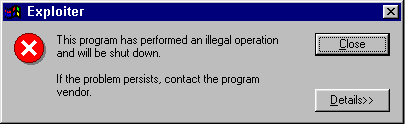
Well, I did it anyway, and the installation really went off without a hitch. The problem came when I tried to install the VMware Tools that come with Workstation. Included in the VMware Tools are the virtual video drivers that would allow me to set my resolution and color scheme. Whenever I tried to install the VMware Tools, Windows would give me the all-to-familiar "illegal operation" dialog box that, honestly, I had almost forgotten about. There wasn't too much I could do. I couldn't get online to download a solution, and if I couldn't install the video drivers, I wouldn't be able to set my color scheme beyond 16 colors, and I needed to get up to 16-bit color.
So I went off in search of another copy of Windows 95. This time I found the latest release that I could, the OEM Service Release 2.5, which was released in late 1997. This version came with Internet Explorer, was released on CD-ROM so I didn't have to keep switching floppies out, and was much more stable. It also came with Hover!, a capture-the-flag style 3D hovercar game that I sunk quite a few summer afternoons into as a kid. That last one didn't really help me achieve my goal, but it was an added bonus. This time installation ran smoothly and the VMware Tools installation ran, but there were errors. Specifically, the video drivers didn't install fully. That was okay though, because they provided instructions at the end of the installer on how to install the drivers manually. I did so and rebooted. Much better.
To test things, I got out my original Fury3 disk. It installed fine, but I noticed that there was no sound.
Sigh.
The sound drivers hadn't installed properly either. This one wasn't easy. I spent several hours browsing online before I found a solution. Apparently, sometimes the sound drivers just don't work in Windows 95. Imagine that. I eventually found a patch that installed different sound drivers. I uninstalled the default sound card, manually set the default to the new one, booted up Fury3, and was treated to this. Awesome.
By the way, as a side-note, Fury3 is a really fun game. I had forgotten that too.
Anyway, with all that done, I set my resolution to 640x480 and put in the Star Trek: Borg CD, excited to finally get to play something I had worked so hard for.
But I had forgotten something. When VMware Tools installed the video drivers, it gave me tons of option for resolution, but only three for color palettes: 16 color, 256 color, and 32-bit color. Of course, when you have 32-bit color why would you ever downgrade to 16-bit color? Except I needed 16-bit color to bypass the check that Star Trek: Borg made.
I was stumped. I had no idea what to do. I did Google search after Google search, and none if it yielded anything. My friend had told me about a patch for the game that just bypassed the three checks, but at the time I told him that wanted to run the game in its native condition. Now that option was looking better and better all the time. I was depressed. I had put all of this effort into something, and I had hit a dead end. I went to bed with the intention of asking my friend for the patch in the morning.
The next morning, I sat down at my computer to do my usual daily routine and noticed something that I had left up the night before. It was the VMware documentation for setting screen color depth. I'm not sure why I hadn't noticed it the night before. According to that documentation, VMware Tools would enable only 16 colors, 256 colors, and whatever color palette the host operating system was using (in my case, 32-bit). With this information, I set my Windows 7 color palette to 16-bit and restarted VMware Workstation. No change. But I wasn't ready to give up yet because now I knew what I was looking for. After a few more searches, I found a small app that would automatically change the virtual machine's operating system's palette to a specified color depth. I downloaded it and set it to 16-bit color.
Star Trek: Borg installed and ran.
I was so excited. It worked, it had sound, and the I did it without modifying the game at all. It was a wonderful feeling.
You might think I'm insane for all of this, but that's okay. It was worth it.
On to the next project.
Monday, December 27, 2010
An Open Letter to Valve Software
Dear Valve Software,
Please stop saving me money on games.
Seriously. Stop it.
It's weird really, because when Steam was first released, it was difficult to find someone who was more opposed to the entire concept than me. I liked having the physical copies of my games, I thought that having to download games was bothersome and took way too long, and I hated the fact that I had to be online to play my offline single-player games.
Man, how times have changed.
These days, if it's a PC game and it's not on Steam, I probably won't buy it. All of the old physical copies of games that I loved so much are now backed up on my hard drive. The physical disks gather dust in my closet. I believe that the last boxed PC game that I bought from a store was Fallout 3 (more than two years ago), and I have no idea what the last one before that was. The time spent downloading is still annoying, but for big releases, I'm able to preload the game in order to play it the second it's released. And I don't even have to leave my house! Being online to play my games is no longer an issue for two reasons: first, I am almost never without an internet connection, and second, if I am without an internet connection, Steam has a fully functional offline mode. Steam is wonderful, Steam is simple, and Steam saves me money on games.
Stop it.
I do not need to be spending $90 for a pack that contains every Star Wars game since 1995. Deus Ex: Invisible War was not that good. I do not need to spend $10 on a digital copy just in case I ever want to play it again. I do not need a $5 copy of every new innovative indie game (of which there seem to be hundreds). And for God's sake, I do not have the reserve capital to keep up with your ridiculous sales.
How do you people make money? Honestly. Today on Steam, you can get Star Wars: Knights of the Old Republic, a game with a Metacritic score of 93%, which cost a full $50 when it was released in 2003, and is to this day one of the finest RPGs ever made, for a meager $2.49. That's ten gumballs from a gumball machine. That's less than half the price of a ticket to a movie. A Big Mac from McDonald's costs more than one of the best games ever. Of course I'm going to buy it.
You can't pass up on deals like that. It's almost unethical to pass up a deal like that. But that's where I get into trouble. Because all of those $2, $5, and $10 purchases add up. I frequently find myself not being able to afford the big blockbuster games because I couldn't pass up the deal on the Space Quest collection. In addition, I don't buy a lot of the big blockbuster games when they come out because I know they'll go on sale at some point. I'm pretty sure I'm the only gamer I know that hasn't played Call of Duty: Black Ops yet because it's still $60 on Steam.
It's relentless too. Just two weeks ago, Steam had a great deal called The Great Steam Treasure Hunt. Every two days there were four new challenges that could be completed through Steam. One usually had to do with something within the program itself, (like have ten friends in the Steam community), one was usually for a blockbuster game (like recruit a companion in Fallout: New Vegas), and the other two were usually for indie games (like get a score of at least 3,770,488 in Beat Hazard). All of the games associated with the challenges were on sale, and every time you completed a challenge, you got one more entry in the raffle. Every two days, Steam gave away five games (the top five games on their wishlists) to twenty people. This went on for two weeks, so a 140 people got five free games. Not terrible odds.
It was fun too. I went in knowing I probably wasn't going to win anything (I didn't), but still did my best to complete as many challenges I could. Of the 28 challenges, I completed 16, and tried out a bunch of great games in the process, some of which I otherwise never would have tried (except Just Cause 2. I did not like that game. It was not worth the $7.50 I paid for it). In the end, I played quite a few new games for the price of one. Not too shabby.
The day the Great Steam Treasure Hunt ended, a new Steam sale started. This time, every day there were thirteen new deals, and for the whole month most of the publisher game bundles were anywhere from 55% to 88% off. The Square Enix/Eidos Complete Pack contains 35 games plus DLC worth a little over $700. Usually, the pack on Steam costs $606. Until January 2, you can get the The Square Enix/Eidos Complete Pack for $75. Again, you can't pass that up. In addition, there's also the eleven indie packs each for $5 that contain 5 games. That's a dollar per game. Right now, you could be playing VVVVVV (which I highly recommend) for the same price as a taco from Taco Bell.
And when you think about it that way, sure. Go ahead. Buy it. Heck, buy all eleven packs, but oops! Now you've spend $55 on 55 indie games that you're never going to play, and you still haven't played Call of Duty: Black Ops.
Argh!
Valve, you have proven to me that you are the master and I am your slave. You do not need to prove it any longer. Please release me from this agony. Please don't make me do stupid things like buy Neverwinter Nights 2 for $10. Please stop saving me money on games.
Sincerely,
Alex Ingraham
P.S. The money that you have made off of me alone should be enough for a new Half-Life game. I'm still waiting, you know.
Please stop saving me money on games.
Seriously. Stop it.
It's weird really, because when Steam was first released, it was difficult to find someone who was more opposed to the entire concept than me. I liked having the physical copies of my games, I thought that having to download games was bothersome and took way too long, and I hated the fact that I had to be online to play my offline single-player games.
Man, how times have changed.
These days, if it's a PC game and it's not on Steam, I probably won't buy it. All of the old physical copies of games that I loved so much are now backed up on my hard drive. The physical disks gather dust in my closet. I believe that the last boxed PC game that I bought from a store was Fallout 3 (more than two years ago), and I have no idea what the last one before that was. The time spent downloading is still annoying, but for big releases, I'm able to preload the game in order to play it the second it's released. And I don't even have to leave my house! Being online to play my games is no longer an issue for two reasons: first, I am almost never without an internet connection, and second, if I am without an internet connection, Steam has a fully functional offline mode. Steam is wonderful, Steam is simple, and Steam saves me money on games.
Stop it.
I do not need to be spending $90 for a pack that contains every Star Wars game since 1995. Deus Ex: Invisible War was not that good. I do not need to spend $10 on a digital copy just in case I ever want to play it again. I do not need a $5 copy of every new innovative indie game (of which there seem to be hundreds). And for God's sake, I do not have the reserve capital to keep up with your ridiculous sales.
How do you people make money? Honestly. Today on Steam, you can get Star Wars: Knights of the Old Republic, a game with a Metacritic score of 93%, which cost a full $50 when it was released in 2003, and is to this day one of the finest RPGs ever made, for a meager $2.49. That's ten gumballs from a gumball machine. That's less than half the price of a ticket to a movie. A Big Mac from McDonald's costs more than one of the best games ever. Of course I'm going to buy it.

You can't pass up on deals like that. It's almost unethical to pass up a deal like that. But that's where I get into trouble. Because all of those $2, $5, and $10 purchases add up. I frequently find myself not being able to afford the big blockbuster games because I couldn't pass up the deal on the Space Quest collection. In addition, I don't buy a lot of the big blockbuster games when they come out because I know they'll go on sale at some point. I'm pretty sure I'm the only gamer I know that hasn't played Call of Duty: Black Ops yet because it's still $60 on Steam.
It's relentless too. Just two weeks ago, Steam had a great deal called The Great Steam Treasure Hunt. Every two days there were four new challenges that could be completed through Steam. One usually had to do with something within the program itself, (like have ten friends in the Steam community), one was usually for a blockbuster game (like recruit a companion in Fallout: New Vegas), and the other two were usually for indie games (like get a score of at least 3,770,488 in Beat Hazard). All of the games associated with the challenges were on sale, and every time you completed a challenge, you got one more entry in the raffle. Every two days, Steam gave away five games (the top five games on their wishlists) to twenty people. This went on for two weeks, so a 140 people got five free games. Not terrible odds.
It was fun too. I went in knowing I probably wasn't going to win anything (I didn't), but still did my best to complete as many challenges I could. Of the 28 challenges, I completed 16, and tried out a bunch of great games in the process, some of which I otherwise never would have tried (except Just Cause 2. I did not like that game. It was not worth the $7.50 I paid for it). In the end, I played quite a few new games for the price of one. Not too shabby.
The day the Great Steam Treasure Hunt ended, a new Steam sale started. This time, every day there were thirteen new deals, and for the whole month most of the publisher game bundles were anywhere from 55% to 88% off. The Square Enix/Eidos Complete Pack contains 35 games plus DLC worth a little over $700. Usually, the pack on Steam costs $606. Until January 2, you can get the The Square Enix/Eidos Complete Pack for $75. Again, you can't pass that up. In addition, there's also the eleven indie packs each for $5 that contain 5 games. That's a dollar per game. Right now, you could be playing VVVVVV (which I highly recommend) for the same price as a taco from Taco Bell.
And when you think about it that way, sure. Go ahead. Buy it. Heck, buy all eleven packs, but oops! Now you've spend $55 on 55 indie games that you're never going to play, and you still haven't played Call of Duty: Black Ops.
Argh!
Valve, you have proven to me that you are the master and I am your slave. You do not need to prove it any longer. Please release me from this agony. Please don't make me do stupid things like buy Neverwinter Nights 2 for $10. Please stop saving me money on games.
Sincerely,
Alex Ingraham
P.S. The money that you have made off of me alone should be enough for a new Half-Life game. I'm still waiting, you know.
Wednesday, November 17, 2010
Stranger in a Strange Land
In July of 2000, PC Gamer, in place of their monthly demo disk, released a CD-ROM containing thirteen classic games from the late eighties and early nineties. Many of the games were not new to me. I had already fallen in love with The Secret of Monkey Island and King's Quest, I had watched my brother play through quite a bit of Descent, and Terminal Velocity was really pretty much the same thing as Fury3. However, there were three games on that disc that I would say truly changed my perspective on gaming: X-COM: UFO Defense, Duke Nukem II, and Ultima I.
I would love to talk about X-COM and Duke Nukem and how they shaped how I think about games today, but that's not what this post is about. This post is about Ultima.
Ultima was not the first Western RPG I ever played. In fact, as I mentioned before, I was pretty well-versed in games by that time. Monkey Island had taught me that video games could make me laugh, Final Fantasy VII had taught me that video games could make me cry, but it wasn't until Ultima that I felt like it impacted me. Before, games were stories about other people, and while I was certainly immersed in some of them, I never felt like I was part of the world. Ultima had this huge world to explore with so many things to see and do. You could steal, and fight, and explore, and go to space, and go back in time, and cast magic, and save princesses, and it all felt like it was something that you were doing. I never referred to The Stranger in third-person. I was the Stranger.
The reason I bring this up is that last Tuesday, I saw Richard Garriott (Lord British; The creator of the Ultima series) speak on a panel called The New World of Gaming hosted by the Rice Alliance at UT. Now, it's been a pretty crazy couple of weeks for me, since the Tuesday before last I saw Neil Gaiman, Adam Savage, Paul and Storm, and the Red vs. Blue guys at W00tstock 2.9, and this weekend I'm going to get to see Billy Dee Williams, Adam West, and Lou Ferrigno at Austin Comic Con [Note: This post was written before I went to Comic-Con, which I can now say was totally awesome.]. However, I have to say that getting a chance to see Lord British in person really takes the cake.
But I really had no idea what I was signing up for.
I went with two friends, neither of whom had played Ultima, but were interested enough to go. They both wore polo shirts and at least semi-nice pants. I wore an over-sized Playstation 3 T-Shirt and a pair of dirty black jeans. For some reason, I thought I would be the one to fit in more. The first thing that we noticed upon arriving was just how many old people there were. Now, granted, Ultima I came out thirty years ago, but even then, the age gap didn't work out. Most of them were also wearing suits. I also found it strange that they would give us vouchers for two free drinks at the bar, though I certainly didn't mind. There was also a buffet included with the price of the ticket ($10 at the door) that had a rather impressive assortment of things to munch on. The vegetable wantons were quite tasty and there were some sort of Italian-fried-cheese-somethings that were absolutely delicious. It was actually while I was eating that I heard a very loud voice directly behind me talking about NASA and space exploration. I didn't really need to turn around to verify that it was, in fact, Lord British standing no more than two feet away from me, but I did anyway.
It was surreal.
Richard Garriott's was the first name I ever heard connected to gaming. He's really an icon in the gaming world, and most of that is due to his real-world persona. He's grotesquely rich, was the first second-generation astronaut, was the first mainstream video game developer in Austin, owns an awesome mansion with secret rooms, and in 2009 he officiated the first-ever wedding on the zero gravity plane. On top of that, he made Ultima! The man just exudes cool. You can imagine how I felt standing right next to him. I nearly choked on my Italian-fired-cheese-something.
I didn't go up to him because I truly had nothing to say. All I could do was sit by the door to the auditorium and wait for the panel to start. When the panel did start, I discovered that there were three other Austinites joining him, none of whom I had ever heard of. One was an investor, another was the CEO of a social gaming company (the creator of Qrank), and I can't really remember who the other guy was. It didn't take me very long to realize that this panel was not at all what I thought it would be. In his opening statements, Richard Garriott split the video game timeline into three segments. The first was an era single-player games, mostly played by nerdy males in their mom's basements, the second was a shift towards multiplayer games which incorporated a bit more of a mainstream audience, and the new dawning age was one of social casual games like Farmville and Qrank. He talked about the fact that games are "reaching all of humanity" through Facebook and mobile devices, and about how that was where the money was. He said that the "Great Equalization" that everyone was hoping that the Internet would bring about didn't happen, and that the only way to succeed as a gaming company was with capital, superior numbers, and top talent; Not necessarily good game design. "Big companies win," he said.
I was a bit taken aback. This wasn't the Richard Garriott I thought I knew. This wasn't the man who took me to Sosaria, has a dead guy in his basement, and fought off a deranged fan with an uzi. This wasn't Richard Garriott the dreamer. This was someone else.
Now, I'm not a starry-eyed romanticist. I know that if you're going to be successful in business, you need to have some sort of business sense. In addition, I know that you need to follow trends and patterns to see where the money is. In this sense, he's right. Social, casual games are making a lot of people a lot of money. But he's right about another thing too:
Gaming is reaching all of humanity.
Call of Duty: Black Ops sold 5.6 million copies on its launch date. More than 10 million people play World of Warcraft. There is a reality TV show called the Tester about people vying for a video game testing job that is being renewed for a second season. There have been video game weddings, video game proposals, video game museums, video game concerts, and extensive video game-related communities with people of all ages, races, genders, backgrounds, and beliefs. Gaming is finally being accepted as a legitimate art form. This is the era of gaming in which it realizes its true potential. Games are now able to tell their stories and share their experiences with a massive whole new congregation, and the man who could be at the forefront of that wants to make another Farmville?
The rest of the night went on in a similar fashion. Questions were asked by the audience, but none of them were about games. At one point Richard Garriott mentioned that he had never employed a game designer that he felt was better than himself, and it took pretty much all I had not to mutter, "Well, that explains Tabula Rasa."
I hate to sound bitter, and in all actuality, I had a great time. The food was great, I learned a lot, and I got to see a childhood hero in the flesh, even if he was a bit different than I expected. I still have an enormous amount of respect for the man, and if he ever decides to do a repeat of the '94 Descent Into Darkness Adventure at Britannia Manor, I'll be first in line, but if I need someone to help me push the boundaries of gaming, I think I'll ask Edmund McMillen.

I would love to talk about X-COM and Duke Nukem and how they shaped how I think about games today, but that's not what this post is about. This post is about Ultima.
Ultima was not the first Western RPG I ever played. In fact, as I mentioned before, I was pretty well-versed in games by that time. Monkey Island had taught me that video games could make me laugh, Final Fantasy VII had taught me that video games could make me cry, but it wasn't until Ultima that I felt like it impacted me. Before, games were stories about other people, and while I was certainly immersed in some of them, I never felt like I was part of the world. Ultima had this huge world to explore with so many things to see and do. You could steal, and fight, and explore, and go to space, and go back in time, and cast magic, and save princesses, and it all felt like it was something that you were doing. I never referred to The Stranger in third-person. I was the Stranger.
The reason I bring this up is that last Tuesday, I saw Richard Garriott (Lord British; The creator of the Ultima series) speak on a panel called The New World of Gaming hosted by the Rice Alliance at UT. Now, it's been a pretty crazy couple of weeks for me, since the Tuesday before last I saw Neil Gaiman, Adam Savage, Paul and Storm, and the Red vs. Blue guys at W00tstock 2.9, and this weekend I'm going to get to see Billy Dee Williams, Adam West, and Lou Ferrigno at Austin Comic Con [Note: This post was written before I went to Comic-Con, which I can now say was totally awesome.]. However, I have to say that getting a chance to see Lord British in person really takes the cake.
But I really had no idea what I was signing up for.
I went with two friends, neither of whom had played Ultima, but were interested enough to go. They both wore polo shirts and at least semi-nice pants. I wore an over-sized Playstation 3 T-Shirt and a pair of dirty black jeans. For some reason, I thought I would be the one to fit in more. The first thing that we noticed upon arriving was just how many old people there were. Now, granted, Ultima I came out thirty years ago, but even then, the age gap didn't work out. Most of them were also wearing suits. I also found it strange that they would give us vouchers for two free drinks at the bar, though I certainly didn't mind. There was also a buffet included with the price of the ticket ($10 at the door) that had a rather impressive assortment of things to munch on. The vegetable wantons were quite tasty and there were some sort of Italian-fried-cheese-somethings that were absolutely delicious. It was actually while I was eating that I heard a very loud voice directly behind me talking about NASA and space exploration. I didn't really need to turn around to verify that it was, in fact, Lord British standing no more than two feet away from me, but I did anyway.
It was surreal.
Richard Garriott's was the first name I ever heard connected to gaming. He's really an icon in the gaming world, and most of that is due to his real-world persona. He's grotesquely rich, was the first second-generation astronaut, was the first mainstream video game developer in Austin, owns an awesome mansion with secret rooms, and in 2009 he officiated the first-ever wedding on the zero gravity plane. On top of that, he made Ultima! The man just exudes cool. You can imagine how I felt standing right next to him. I nearly choked on my Italian-fired-cheese-something.
I didn't go up to him because I truly had nothing to say. All I could do was sit by the door to the auditorium and wait for the panel to start. When the panel did start, I discovered that there were three other Austinites joining him, none of whom I had ever heard of. One was an investor, another was the CEO of a social gaming company (the creator of Qrank), and I can't really remember who the other guy was. It didn't take me very long to realize that this panel was not at all what I thought it would be. In his opening statements, Richard Garriott split the video game timeline into three segments. The first was an era single-player games, mostly played by nerdy males in their mom's basements, the second was a shift towards multiplayer games which incorporated a bit more of a mainstream audience, and the new dawning age was one of social casual games like Farmville and Qrank. He talked about the fact that games are "reaching all of humanity" through Facebook and mobile devices, and about how that was where the money was. He said that the "Great Equalization" that everyone was hoping that the Internet would bring about didn't happen, and that the only way to succeed as a gaming company was with capital, superior numbers, and top talent; Not necessarily good game design. "Big companies win," he said.
I was a bit taken aback. This wasn't the Richard Garriott I thought I knew. This wasn't the man who took me to Sosaria, has a dead guy in his basement, and fought off a deranged fan with an uzi. This wasn't Richard Garriott the dreamer. This was someone else.
Now, I'm not a starry-eyed romanticist. I know that if you're going to be successful in business, you need to have some sort of business sense. In addition, I know that you need to follow trends and patterns to see where the money is. In this sense, he's right. Social, casual games are making a lot of people a lot of money. But he's right about another thing too:
Gaming is reaching all of humanity.
Call of Duty: Black Ops sold 5.6 million copies on its launch date. More than 10 million people play World of Warcraft. There is a reality TV show called the Tester about people vying for a video game testing job that is being renewed for a second season. There have been video game weddings, video game proposals, video game museums, video game concerts, and extensive video game-related communities with people of all ages, races, genders, backgrounds, and beliefs. Gaming is finally being accepted as a legitimate art form. This is the era of gaming in which it realizes its true potential. Games are now able to tell their stories and share their experiences with a massive whole new congregation, and the man who could be at the forefront of that wants to make another Farmville?

The rest of the night went on in a similar fashion. Questions were asked by the audience, but none of them were about games. At one point Richard Garriott mentioned that he had never employed a game designer that he felt was better than himself, and it took pretty much all I had not to mutter, "Well, that explains Tabula Rasa."
I hate to sound bitter, and in all actuality, I had a great time. The food was great, I learned a lot, and I got to see a childhood hero in the flesh, even if he was a bit different than I expected. I still have an enormous amount of respect for the man, and if he ever decides to do a repeat of the '94 Descent Into Darkness Adventure at Britannia Manor, I'll be first in line, but if I need someone to help me push the boundaries of gaming, I think I'll ask Edmund McMillen.
Saturday, November 6, 2010
Bad For Thinking
In light of my previous post, a friend of mine asked me to post the original list of my top ten favorite scary games. Here they are:
10. Amnesia: The Dark Descent
9. System Shock 2
8. F.E.A.R.
7. Aliens versus Predator 2
6. Doom 3
5. Silent Hill 3
4. Half-Life
3. Eternal Darkness - Sanity's Requiem
2. Resident Evil - REmake
1. Silent Hill 2
Note that these are my "favorite scary games," rather than "games that have scared me the most." I found Doom 3 to be a much scarier game than Half-Life, for example, but Half-Life is definitely my favorite of the two.
Aquick anecdote about a game I feel should get an honorable mention:
One of the very first real games I ever played as a kid was Star Wars: Dark Forces, a Doom-style first-person shooter. It was passed on to me (along with the CD-ROM version of the first two Prince of Persia games) by my brother when I was eight. I had never played a first-person shooter before, so it took me a while to even beat the first level, but when I did, I really got into it. In the third level, however, Kyle Katarn (the main character) visits the sewers of Anoat City to track down an Imperial weapons designer. With the exception of a couple of interrogation droids, the only monsters in the level were the dianogas that lived under the water. You couldn't see them, you couldn't go under the water, and the only hint that you had that they were there was the occasional eyeball stalk that would pop out of the murky water to look around. The sewer would be quiet for a while, and then suddenly you would have have this in your face:

To my knowledge, as of today, my mother has only ever played two video games: Dance Dance Revolution (a completely separate, yet fun story) and the third level of Dark Forces. I would stand behind her, facing away from the screen and she would describe her surroundings. It took us a good chunk of the summer, but together, we navigated the labyrinth-like sewer, and while she never actually beat the level herself, she got me close enough that I was able to make a mad dash for the exit.
Of course, Dark Forces isn't a horror game. In fact, while Anoat City is still pretty horrifying to this day (I had to play it in order to take the above screenshot. I won't lie, my heart was racing a bit), the rest of the game is pretty tame. It's for this reason that it only gets an honorable mention, but it has a very special place in my heart.
10. Amnesia: The Dark Descent
9. System Shock 2
8. F.E.A.R.
7. Aliens versus Predator 2
6. Doom 3
5. Silent Hill 3
4. Half-Life
3. Eternal Darkness - Sanity's Requiem
2. Resident Evil - REmake
1. Silent Hill 2
Note that these are my "favorite scary games," rather than "games that have scared me the most." I found Doom 3 to be a much scarier game than Half-Life, for example, but Half-Life is definitely my favorite of the two.
A
One of the very first real games I ever played as a kid was Star Wars: Dark Forces, a Doom-style first-person shooter. It was passed on to me (along with the CD-ROM version of the first two Prince of Persia games) by my brother when I was eight. I had never played a first-person shooter before, so it took me a while to even beat the first level, but when I did, I really got into it. In the third level, however, Kyle Katarn (the main character) visits the sewers of Anoat City to track down an Imperial weapons designer. With the exception of a couple of interrogation droids, the only monsters in the level were the dianogas that lived under the water. You couldn't see them, you couldn't go under the water, and the only hint that you had that they were there was the occasional eyeball stalk that would pop out of the murky water to look around. The sewer would be quiet for a while, and then suddenly you would have have this in your face:


Okay, so kids today may have their Flood and their Locusts, and I'm sure that they all make the dianoga from Dark Forces look laughable today, but to an eight year-old in 1996, this was what terror looked like.


So, I had this problem. I loved the game, and I wanted to continue, but I was too afraid to even start the level, let alone finish it. So I got this brilliant idea: I would get my mother to play it. After all, any other time that I was afraid of something, I would just get Mom to take care of it. I remember quite vividly what it was that I told her to convince her to come upstairs to see Dark Forces. I said, "Hey Mom, have you ever wondered what the monster that dragged Luke under the water in Star Wars looked like?" And my poor, sweet mother who, at the time, was lying on her bed, peacefully reading a book and drinking tea, looked up at me and said, "You know, I always have."
It is one of my most cherished summer memories.
Of course, Dark Forces isn't a horror game. In fact, while Anoat City is still pretty horrifying to this day (I had to play it in order to take the above screenshot. I won't lie, my heart was racing a bit), the rest of the game is pretty tame. It's for this reason that it only gets an honorable mention, but it has a very special place in my heart.
Friday, November 5, 2010
Restless Dreams
Since Halloween was last weekend, I was going to use this post to talk about my top ten favorite horror games and what I think makes them both scary and good. However, after making my list, I discovered that the only thing I had any real interest in talking about was the game at my number one spot: Silent Hill 2.
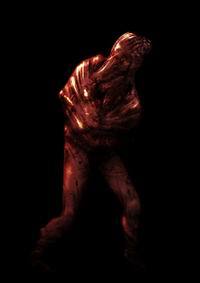
In addition to being my favorite horror game, Silent Hill 2 is present on my short list of greatest games of all time. It tells the story of James Sunderland, a somber, estranged man who has lost his wife to an unspecified incurable disease. Three years after his wife's death, he receives a letter from her, beckoning him to the town of Silent Hill. Upon arriving, James finds the permanently foggy town completely abandoned save for a little girl, two emotionally unstable characters, and hordes of hellish, grotesque monsters. In addition, he finds a woman named Maria who looks exactly like his dead wife, only younger and sexier. Each character is an interesting addition to the roster, wandering around in their own little world and dealing with the emotional baggage that plagues them. It is strongly hinted at throughout the entire game that while Silent Hill is definitely a place where one faces demons, they aren't always the kind that go bump in the night.
There are many things that make Silent Hill 2 special. Here's my top five.
1. James
James' story is one of self-discovery. He has secrets locked away in his mind that he can't bear to remember. Everything in Silent Hill drips with symbolism and insight into his psyche. In fact, even the other characters seem to exist solely to highlight James' story. Learning the truth about Angela and Eddie's pasts gives the player insight into the kinds of people that Silent Hill attracts and makes them question what kind of a character they've been controlling. Each monster is specifically designed to bring out an aspect of James' personality, including the villain that the series is most known for: Pyramid Head. It all comes together to create the most personal story I've ever seen in a game. During the course of the story, you become very connected to James, which is both fascinating and very disturbing. It's particularly interesting because even at the end of the game, we know very little about his life. A short blurb in the Silent Hill 3 strategy guide mentions that he was a clerk, and we know that he took vacations with his wife to Silent Hill, but that's really all we know about his past. And yet, at the end of the game, I felt like I knew everything about him. The game focuses on James so heavily that at times it just feels like a character analysis, and if you've got a character that's interesting enough, that's definitely not a bad thing.
2. Horror
I feel like good horror can make you scared of anything. Silent Hill 2 made me scared of fog, rust, water, sewers, prisons, museums, hospitals, mannequins, nurses, straitjackets, stairs, meat lockers, the dark, and Pyramid Head. That's quite a laundry list for one game. What makes it even more impressive is that Silent Hill 2 does not contain a single scripted pop-out scare in the entire game. Every scare in the game is executed by means of atmosphere, superior design, and a tense, gnawing feeling that the game is messing with your mind. Oh, and Pyramid Head.Towards the end of the game, there's this really long boat ride out to a hotel in the middle of a lake. You control the boat the whole time, and the ride goes on for so long that at first you start thinking that you're missing something. Then, you start thinking that something is going to pop out at you any moment. There's no shadows in the water, no dramatic music, but you feel it, like hot breath on your neck. The ride continues, soundless and static, and you start to grind your teeth, bracing yourself for the coming attack, but none ever comes. When you finally arrive at your destination, you breathe a heavy sigh of relief. Silent Hill spared you this time. Of course, in retrospect, there was nothing in the lake. I KNOW there's nothing in the lake, and yet every time I get through that segment, I feel as if the town itself is letting me go; allowing me to live, so that I can face my demons at the hotel. It's the kind of stuff that stays with you. A while back, I was driving through Houston pretty early on a weekend. I was the only car on the road, and a deep, thick fog hung over the city. I put on the Silent Hill soundtrack and drove right through. It was one of the creepiest things I've ever experienced.
3. Emotional Atmosphere
If I could pick one word to describe Silent Hill 2, it's 'melancholy.' It's a strange departure from most horror, which is tense, adrenaline-driven, and exciting. Silent Hill 2 is slow, sluggish, and feels emotionally draining. James, in particular, drives this feeling forward with an estranged, alienated attitude that really makes it seem like he has nothing to live for. He cares about finding his wife, but never really gets passionate about it. It always feels as though he knows that his wife is dead and that he will never find her, but just can't let it go. I really applaud the designers for their attention to detail in this respect. Everything from the voice acting, to the writing on the walls, to the fact that James doesn't even close his car door when he goes into the town accentuates the feelings of loneliness and despair that the characters all feel. Long before you know the ending, you know it can't go well. There is no light in Silent Hill.
4.Bending the medium
Silent Hill 2 really pushes the gaming medium for all it's worth. It defies convention at every turn. In fact, just as a video game, it's actually kind of terrible. The controls are clunky, there's not a lot of weapon variety, combat is boring, and the pacing is slow. Oddly enough, however, it all seems to work in its favor. In the "Making Of Silent Hill 2" documentary they mention the fact that it takes ten minutes of running down roads just to get into Silent Hill. Then, there's another five minutes before you see the first monster. It was a stylistic choice to make it seem like the town was really, truly isolated. There are very few games that have the guts to withhold combat for fifteen minutes, but they knew that they were taking risks by bending the rules, and it worked. The clunky control scheme and the bad camera actually heighten the tension in scary situations, and the non-conventional story really makes it stand out as one of the best game narratives of all time.
5. Silent Hill
Silent Hill is more than just the name and setting of the game. It's also a main character. It pushes James in the direction he needs to go and guides him down his path of discovery. Sections of the town are often blocked off or completely missing. The town is in control at all times and it makes you feel very small and powerless. For me, one of the things that makes the town so interesting is that while you know that it's powerful and that it attracts a certain type of psychopath, you never really know what it is. Is it a place of punishment or redemption? Does it have a mind of it's own or does it just manifest what's in its occupants' heads? Is it somehow a benign force or does it have true malicious intent? This ambiguity is addressed in the game's six endings. In most games with multiple endings, which ending you receive is based on a decision (sometimes two) that you make in the story. Silent Hill 2, however, gives you an ending based on how you play the game, and it takes in a lot of factors. What you choose to look at, how much time you spend in certain areas, and even how much time you spend with low health all affect the ending you receive. This doesn't just shape the character of James. It changes what the town means to James through every choice he makes.
If you're a gamer who has never played Silent Hill 2, you really owe it to yourself to give it a shot, even if you're not a horror fan. It's one of my favorites, and when Roger Ebert comes knocking on my door to prove him wrong, it's the first thing I'm going to show him.
In addition to being my favorite horror game, Silent Hill 2 is present on my short list of greatest games of all time. It tells the story of James Sunderland, a somber, estranged man who has lost his wife to an unspecified incurable disease. Three years after his wife's death, he receives a letter from her, beckoning him to the town of Silent Hill. Upon arriving, James finds the permanently foggy town completely abandoned save for a little girl, two emotionally unstable characters, and hordes of hellish, grotesque monsters. In addition, he finds a woman named Maria who looks exactly like his dead wife, only younger and sexier. Each character is an interesting addition to the roster, wandering around in their own little world and dealing with the emotional baggage that plagues them. It is strongly hinted at throughout the entire game that while Silent Hill is definitely a place where one faces demons, they aren't always the kind that go bump in the night.



There are many things that make Silent Hill 2 special. Here's my top five.
1. James
James' story is one of self-discovery. He has secrets locked away in his mind that he can't bear to remember. Everything in Silent Hill drips with symbolism and insight into his psyche. In fact, even the other characters seem to exist solely to highlight James' story. Learning the truth about Angela and Eddie's pasts gives the player insight into the kinds of people that Silent Hill attracts and makes them question what kind of a character they've been controlling. Each monster is specifically designed to bring out an aspect of James' personality, including the villain that the series is most known for: Pyramid Head. It all comes together to create the most personal story I've ever seen in a game. During the course of the story, you become very connected to James, which is both fascinating and very disturbing. It's particularly interesting because even at the end of the game, we know very little about his life. A short blurb in the Silent Hill 3 strategy guide mentions that he was a clerk, and we know that he took vacations with his wife to Silent Hill, but that's really all we know about his past. And yet, at the end of the game, I felt like I knew everything about him. The game focuses on James so heavily that at times it just feels like a character analysis, and if you've got a character that's interesting enough, that's definitely not a bad thing.


2. Horror
I feel like good horror can make you scared of anything. Silent Hill 2 made me scared of fog, rust, water, sewers, prisons, museums, hospitals, mannequins, nurses, straitjackets, stairs, meat lockers, the dark, and Pyramid Head. That's quite a laundry list for one game. What makes it even more impressive is that Silent Hill 2 does not contain a single scripted pop-out scare in the entire game. Every scare in the game is executed by means of atmosphere, superior design, and a tense, gnawing feeling that the game is messing with your mind. Oh, and Pyramid Head.Towards the end of the game, there's this really long boat ride out to a hotel in the middle of a lake. You control the boat the whole time, and the ride goes on for so long that at first you start thinking that you're missing something. Then, you start thinking that something is going to pop out at you any moment. There's no shadows in the water, no dramatic music, but you feel it, like hot breath on your neck. The ride continues, soundless and static, and you start to grind your teeth, bracing yourself for the coming attack, but none ever comes. When you finally arrive at your destination, you breathe a heavy sigh of relief. Silent Hill spared you this time. Of course, in retrospect, there was nothing in the lake. I KNOW there's nothing in the lake, and yet every time I get through that segment, I feel as if the town itself is letting me go; allowing me to live, so that I can face my demons at the hotel. It's the kind of stuff that stays with you. A while back, I was driving through Houston pretty early on a weekend. I was the only car on the road, and a deep, thick fog hung over the city. I put on the Silent Hill soundtrack and drove right through. It was one of the creepiest things I've ever experienced.


3. Emotional Atmosphere
If I could pick one word to describe Silent Hill 2, it's 'melancholy.' It's a strange departure from most horror, which is tense, adrenaline-driven, and exciting. Silent Hill 2 is slow, sluggish, and feels emotionally draining. James, in particular, drives this feeling forward with an estranged, alienated attitude that really makes it seem like he has nothing to live for. He cares about finding his wife, but never really gets passionate about it. It always feels as though he knows that his wife is dead and that he will never find her, but just can't let it go. I really applaud the designers for their attention to detail in this respect. Everything from the voice acting, to the writing on the walls, to the fact that James doesn't even close his car door when he goes into the town accentuates the feelings of loneliness and despair that the characters all feel. Long before you know the ending, you know it can't go well. There is no light in Silent Hill.


4.Bending the medium
Silent Hill 2 really pushes the gaming medium for all it's worth. It defies convention at every turn. In fact, just as a video game, it's actually kind of terrible. The controls are clunky, there's not a lot of weapon variety, combat is boring, and the pacing is slow. Oddly enough, however, it all seems to work in its favor. In the "Making Of Silent Hill 2" documentary they mention the fact that it takes ten minutes of running down roads just to get into Silent Hill. Then, there's another five minutes before you see the first monster. It was a stylistic choice to make it seem like the town was really, truly isolated. There are very few games that have the guts to withhold combat for fifteen minutes, but they knew that they were taking risks by bending the rules, and it worked. The clunky control scheme and the bad camera actually heighten the tension in scary situations, and the non-conventional story really makes it stand out as one of the best game narratives of all time.
5. Silent Hill
Silent Hill is more than just the name and setting of the game. It's also a main character. It pushes James in the direction he needs to go and guides him down his path of discovery. Sections of the town are often blocked off or completely missing. The town is in control at all times and it makes you feel very small and powerless. For me, one of the things that makes the town so interesting is that while you know that it's powerful and that it attracts a certain type of psychopath, you never really know what it is. Is it a place of punishment or redemption? Does it have a mind of it's own or does it just manifest what's in its occupants' heads? Is it somehow a benign force or does it have true malicious intent? This ambiguity is addressed in the game's six endings. In most games with multiple endings, which ending you receive is based on a decision (sometimes two) that you make in the story. Silent Hill 2, however, gives you an ending based on how you play the game, and it takes in a lot of factors. What you choose to look at, how much time you spend in certain areas, and even how much time you spend with low health all affect the ending you receive. This doesn't just shape the character of James. It changes what the town means to James through every choice he makes.
If you're a gamer who has never played Silent Hill 2, you really owe it to yourself to give it a shot, even if you're not a horror fan. It's one of my favorites, and when Roger Ebert comes knocking on my door to prove him wrong, it's the first thing I'm going to show him.
Friday, October 22, 2010
Life Finds A Way
A little while back, Telltale Games announced that their next two titles would be licensed from Universal Pictures and that they would be set in the Back to the Future and Jurassic Park universes, respectively. I'm a huge fan of Telltale, so my initial reaction was one of obnoxiously loud excitement. Telltale has made games out Bone (probably one of my favorite comics ever), brought back Sam and Max, and revived the Monkey Island series (certainly my favorite adventure game series ever). I truly believe that Telltale is 90% responsible for the recent resurgence of quality adventure games, and in my mind, they can truly do no wrong. Whose hands would be better to leave two of my favorite movie franchises in?
The more I thought about it, however, the more I started to bite my nails.
Back to the Future is fine. It actually shares a lot with the Monkey Island series in terms of tone. It's funny, it's balances a lighthearted and epic storyline at the same time, and focuses on the characters and their interactions. Therefore, it was no surprise to me that when Telltale finally released this concept art for the new Back to the Future game, it looked genuinely awesome. Jurassic Park, though?
Do me a favor, and take a look at the following image:

Look real hard. These are some of the featured characters from Telltale's biggest franchises. What you have here is a sarcastic Mexican wrestler, two anthropomorphic detectives, a bumbling mighty pirate, a prehistoric animal that feasts on the flesh of living things and strikes fear into the hearts of children across the world, and a goofy inventor who lives with a dog.
One of theses things is not like the others.
It's not that I think that Jurassic Park can't be translated into a video game. After all, there have been many Jurassic Park games running the full range of good, bad, and ugly. What makes me hesitate is that Telltale games (to date) tend to follow the same shtick: Light, episodic, cartoony adventure games with a sense of humor. It's a great shtick and I'm all for branching out, but it seems like they might be a little bit over their heads with this one. So, Telltale, just in case you're a bit stuck, here are five things that I think a good Jurassic Park game should be.
A Jurassic Park game should be:
1. Dark and terrifying
Remember that part in Jurassic Park where Robert Muldoon (the Australian guy) is sitting in the bushes trying to line up a shot to kill a Velociraptor and another Velociraptor pops up right beside him and he realizes for two brief seconds that he's been ambushed before he is viciously torn apart and devoured? Remember how afterwards you had to change your underwear, couldn't sleep at night, and to this day are scared to death of the jungle?
Jurassic Park is a scary movie based on a scary book based on a scary group of animals that we'd better be glad can't be resurrected in real life because they would eat us. That's part of what makes it good.
A Jurassic Park game should capture that feeling and run with it. The atmosphere should be tense. We should hear the distant roars of different dinosaurs, find the bodies of their victims, see them dart through the trees, and hope that they're full. When we come face to face with a dinosaur, we should feel like I'm sure Robert Muldoon did after that second raptor popped out: scared out of our minds.
2. An adventure game
As far as I know, there has never been a Jurassic Park adventure game, and I think it's a pretty good idea. First, it gives Telltale a comfortable foundation and an opportunity to experiment with something that they're good at. Second, I feel like there's a lot of unexplored opportunities for puzzles within the Jurassic Park universe. Most adventure game puzzles require communication with other (semi)intelligent beings and interaction with relatively static environments, but Jurassic Park is alive and mostly devoid of human life. I would love to see the dinosaurs be incorporated into puzzles in different ways. In addition, adventure games are usually non-combat. Not having combat would lead to all sorts of interesting and terrifying survival situations. I think a non-combat survival adventure game set in Jurassic Park would be awesome.
3. About characters we care about
I don't necessarily want to rehash characters from previous books and movies, but I do want to care about them. This is one area where I'm sure Telltale can knock it out of the park. Before the Dilophosaurus spit hits the fan, we need to have a good read on each character, their personalities, and their flaws. One of the many reasons that the second and third movies were so terrible was that the characters were all stilted stereotypes that no one could find interesting. Every character in the first movie was developed enough that we had at least one reason that we didn't want them to get eaten by a T-Rex.
One thing that I find interesting about the (mostly terrible) new Jurassic Park comic book is that the main characters are adult versions of Lex and Tim, the kids from the first movie, but they're very different. Lex grows up trying to preserve the island and its scaly inhabitants and tries to protect them from the outside world while Tim tries to keep his grandfather's dream alive by opening a new, much more secure, carnivore-free park. They are constantly at odds, working at every chance to sabotage the other's plans, even though they still love each other.
That's the kind of emotional investment that we need out of a game. We need something besides "let's go back to the island because [insert stupid MacGuffin here]" as a plot.
4. Set on Isla Nublar
Okay, this one is really just a personal thing, but think about the Jurassic Park series for a second. There has been exactly one book, one movie, and one game (possibly two) that have had the words "Jurassic Park" in the title and not been terrible. What do they all have in common? Isla Nublar.
See, there's two islands with dinosaurs on them in the Jurassic Park universe: Isla Nublar (Jurassic Park) and Isla Sorna (Lost World, Jurassic Park III). Isla Sorna is the location of "Site B," a facility where the dinosaurs were allowed to mature before being sent to the park. Every story that has ever taken place on Isla Sorna has been awful. We could speculate that this is because we don't get the feeling of lost security on Isla Sorna or that the lack of human element detracts from the experience. But, seriously? I think the place is cursed, and I don't want to go back there again.
5. Awe-inspiring and breath-taking.
Jurassic Park is not just about watching people get torn up by dinosaurs. It's about trying and failing to control something bigger than you, human beings fighting nature, and ultimately, about life finding a way. These are grandiose themes that should be met with grandiose images. The first few minutes on the island in Jurassic Park make up one of my favorite moments in movie history. The beautiful scenery, the tearfully moving music, and the juxtaposition of human beings to such magnanimous creatures are what separate Jurassic Park from every other creature thriller out there.
You should feel tiny in a Jurassic Park game, like you're part of a bigger world that you couldn't control even if you had the desire to. There should be mountains, waterfalls, and rich jungles full of life. The main character of any good Jurassic Park story is nature itself. Whoever you play as in this game should be out of his/her element, and it should be beautiful.
That's not too much to ask, right?
The more I thought about it, however, the more I started to bite my nails.
Back to the Future is fine. It actually shares a lot with the Monkey Island series in terms of tone. It's funny, it's balances a lighthearted and epic storyline at the same time, and focuses on the characters and their interactions. Therefore, it was no surprise to me that when Telltale finally released this concept art for the new Back to the Future game, it looked genuinely awesome. Jurassic Park, though?

Do me a favor, and take a look at the following image:

Look real hard. These are some of the featured characters from Telltale's biggest franchises. What you have here is a sarcastic Mexican wrestler, two anthropomorphic detectives, a bumbling mighty pirate, a prehistoric animal that feasts on the flesh of living things and strikes fear into the hearts of children across the world, and a goofy inventor who lives with a dog.
One of theses things is not like the others.
It's not that I think that Jurassic Park can't be translated into a video game. After all, there have been many Jurassic Park games running the full range of good, bad, and ugly. What makes me hesitate is that Telltale games (to date) tend to follow the same shtick: Light, episodic, cartoony adventure games with a sense of humor. It's a great shtick and I'm all for branching out, but it seems like they might be a little bit over their heads with this one. So, Telltale, just in case you're a bit stuck, here are five things that I think a good Jurassic Park game should be.
A Jurassic Park game should be:
1. Dark and terrifying
Remember that part in Jurassic Park where Robert Muldoon (the Australian guy) is sitting in the bushes trying to line up a shot to kill a Velociraptor and another Velociraptor pops up right beside him and he realizes for two brief seconds that he's been ambushed before he is viciously torn apart and devoured? Remember how afterwards you had to change your underwear, couldn't sleep at night, and to this day are scared to death of the jungle?

Jurassic Park is a scary movie based on a scary book based on a scary group of animals that we'd better be glad can't be resurrected in real life because they would eat us. That's part of what makes it good.
A Jurassic Park game should capture that feeling and run with it. The atmosphere should be tense. We should hear the distant roars of different dinosaurs, find the bodies of their victims, see them dart through the trees, and hope that they're full. When we come face to face with a dinosaur, we should feel like I'm sure Robert Muldoon did after that second raptor popped out: scared out of our minds.
2. An adventure game
As far as I know, there has never been a Jurassic Park adventure game, and I think it's a pretty good idea. First, it gives Telltale a comfortable foundation and an opportunity to experiment with something that they're good at. Second, I feel like there's a lot of unexplored opportunities for puzzles within the Jurassic Park universe. Most adventure game puzzles require communication with other (semi)intelligent beings and interaction with relatively static environments, but Jurassic Park is alive and mostly devoid of human life. I would love to see the dinosaurs be incorporated into puzzles in different ways. In addition, adventure games are usually non-combat. Not having combat would lead to all sorts of interesting and terrifying survival situations. I think a non-combat survival adventure game set in Jurassic Park would be awesome.
3. About characters we care about
I don't necessarily want to rehash characters from previous books and movies, but I do want to care about them. This is one area where I'm sure Telltale can knock it out of the park. Before the Dilophosaurus spit hits the fan, we need to have a good read on each character, their personalities, and their flaws. One of the many reasons that the second and third movies were so terrible was that the characters were all stilted stereotypes that no one could find interesting. Every character in the first movie was developed enough that we had at least one reason that we didn't want them to get eaten by a T-Rex.
One thing that I find interesting about the (mostly terrible) new Jurassic Park comic book is that the main characters are adult versions of Lex and Tim, the kids from the first movie, but they're very different. Lex grows up trying to preserve the island and its scaly inhabitants and tries to protect them from the outside world while Tim tries to keep his grandfather's dream alive by opening a new, much more secure, carnivore-free park. They are constantly at odds, working at every chance to sabotage the other's plans, even though they still love each other.
That's the kind of emotional investment that we need out of a game. We need something besides "let's go back to the island because [insert stupid MacGuffin here]" as a plot.
4. Set on Isla Nublar
Okay, this one is really just a personal thing, but think about the Jurassic Park series for a second. There has been exactly one book, one movie, and one game (possibly two) that have had the words "Jurassic Park" in the title and not been terrible. What do they all have in common? Isla Nublar.
See, there's two islands with dinosaurs on them in the Jurassic Park universe: Isla Nublar (Jurassic Park) and Isla Sorna (Lost World, Jurassic Park III). Isla Sorna is the location of "Site B," a facility where the dinosaurs were allowed to mature before being sent to the park. Every story that has ever taken place on Isla Sorna has been awful. We could speculate that this is because we don't get the feeling of lost security on Isla Sorna or that the lack of human element detracts from the experience. But, seriously? I think the place is cursed, and I don't want to go back there again.
5. Awe-inspiring and breath-taking.
Jurassic Park is not just about watching people get torn up by dinosaurs. It's about trying and failing to control something bigger than you, human beings fighting nature, and ultimately, about life finding a way. These are grandiose themes that should be met with grandiose images. The first few minutes on the island in Jurassic Park make up one of my favorite moments in movie history. The beautiful scenery, the tearfully moving music, and the juxtaposition of human beings to such magnanimous creatures are what separate Jurassic Park from every other creature thriller out there.
You should feel tiny in a Jurassic Park game, like you're part of a bigger world that you couldn't control even if you had the desire to. There should be mountains, waterfalls, and rich jungles full of life. The main character of any good Jurassic Park story is nature itself. Whoever you play as in this game should be out of his/her element, and it should be beautiful.
That's not too much to ask, right?
Subscribe to:
Posts (Atom)